
The Twin Transition Also Needs a Quality Transition in VET
A vocational programme can be updated and still fail to prepare learners for the jobs it is meant to serve.
Europe often presents the green and digital transitions as a skills challenge. Workers need new competences, companies need evolving occupational profiles, and vocational education and training providers need to modernise their programmes.
But one question receives far less attention:
How do we know whether these updated programmes are actually preparing learners for changing workplaces?
Adding a sustainability module does not automatically develop green competences. Purchasing digital equipment does not guarantee meaningful digital learning. Introducing artificial intelligence into a curriculum does not prove that graduates can use it effectively, critically or responsibly.
The real test is whether learners can apply their knowledge in practice and whether VET providers can recognise when their programmes are no longer keeping pace with occupational change.
Change is happening within existing occupations
The twin transition is not only creating entirely new professions. It is also transforming the tasks performed within established occupations.
Electricians may increasingly need to work with photovoltaic installations, charging infrastructure and smart energy systems. Construction professionals face changing expectations related to circularity, materials and energy efficiency. Administrative workers are expected to use automated processes, data platforms and AI-supported tools.
The 2025 practical guide developed by Cedefop and UNESCO-UNEVOC highlights the importance of combining sound skills intelligence with effective governance and practical implementation. Information about emerging skills must be translated into curricula, apprenticeships, upskilling, reskilling and other concrete VET measures [1].
But updating a programme is only the beginning. The next question is whether these changes produce better learning and more relevant outcomes.
Quality assurance must follow the complete cycle
The EQAVET Framework is built around four connected stages: Planning → Implementation → Evaluation → Review
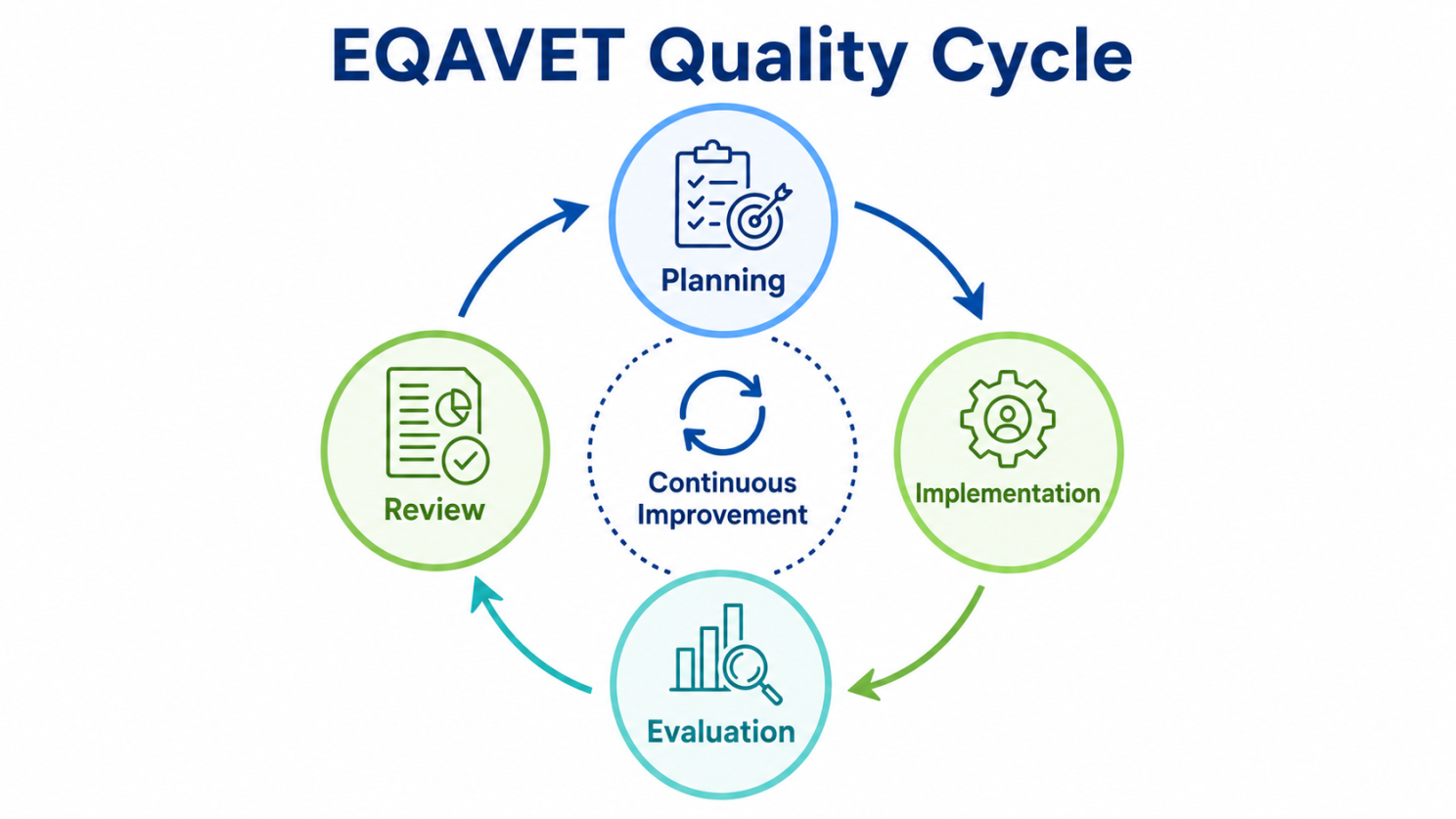
The cycle supports continuous improvement across initial and continuing VET, apprenticeships, work-based learning, blended provision and different types of qualifications [2].
However, the tools supporting these four stages do not appear to be used equally. According to the 2022 EQAVET National Reference Points survey, published by the European Commission in 2023, 24 of the 28 countries surveyed used the EQAVET quality cycle. The survey also found that EQAVET indicative descriptors were used more frequently during planning and implementation than during evaluation and review [3].
This imbalance matters.
For the twin transition, evaluation and review cannot be treated as secondary administrative stages. They are the stages in which the relevance of programme changes must be tested.
Quality assurance should ask:
→ Can learners demonstrate the required competences in realistic situations?
→ Do employers consider graduates prepared for current workplace tasks?
→ Are teachers and trainers equipped to deliver and assess the updated content?
→ Does feedback from learners, graduates and employers lead to visible programme improvements?
Without these questions, curriculum innovation risks becoming another box to tick.
More data does not automatically mean better quality
Digitalisation is also changing how VET is delivered, monitored and evaluated.
In April 2026, an EQAVET peer review examined the quality assurance system used by VET providers in the Canary Islands. The system supports structured self-evaluation and improvement planning through a dedicated digital platform.
Importantly, the discussion did not focus only on the platform itself. It also examined which types of data could demonstrate progress in areas such as employability, cooperation with companies and innovation in training programmes [4].
This distinction is crucial.
VET providers do not simply need more data. They need evidence that helps them make better decisions.
A related lesson emerged from an EQAVET peer review organised by the Portuguese National Reference Point in June 2026. The review highlighted the importance of employer participation in curriculum co-design, work-based learning and feedback mechanisms. It also identified the need to move from informal employer contacts towards more systematic and structured stakeholder engagement [5].
Effective quality assurance therefore depends on more than indicators and digital tools. It requires meaningful relationships between providers, employers, educators, learners and policymakers.
Strengthening the feedback loop through EQAVET 4.0
EQAVET 4.0 is developing a structured methodology to improve alignment between sectoral needs, occupational qualifications and the outcomes of VET programmes.
Its work includes sectoral mapping, detailed job profiles and assessment tools designed to examine graduates’ competences, employer satisfaction and overall programme effectiveness [6].
Together, these elements can make the full feedback loop more visible:
Sectoral change → occupational tasks → required competences → learning outcomes → assessment → stakeholder feedback → programme improvement
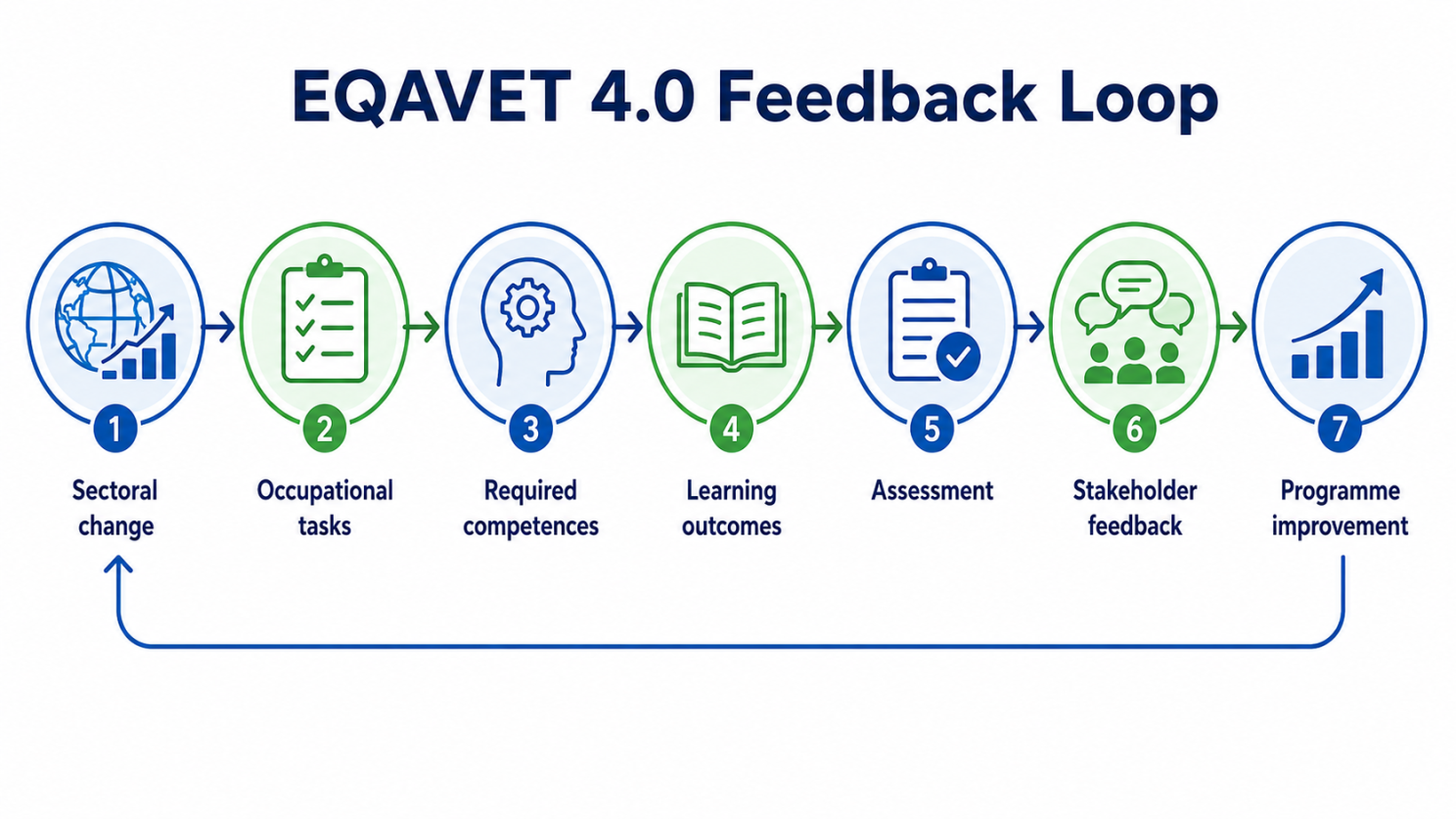
Occupational profiles should not be treated as static documents. They should become living reference points that are regularly tested against workplace evidence and graduate outcomes.
Europe will not complete the green and digital transitions through a single curriculum reform.
It needs VET systems capable of repeatedly identifying change, evaluating its implications and improving provision on the basis of evidence.
The twin transition must therefore also become a quality transition.
How can VET providers, employers and policymakers build stronger feedback loops to ensure that updated programmes lead to better outcomes?
References
[1] Cedefop & UNESCO-UNEVOC (2025). Meeting skill needs for the green transition: Skills anticipation and VET for a greener future—Cedefop practical guide 4. Publications Office of the European Union. DOI: 10.2801/6833866. https://www.cedefop.europa.eu/en/publications/4220
[2] European Commission. EQAVET quality assurance cycle. Employment, Social Affairs and Inclusion. https://employment-social-affairs.ec.europa.eu/policies-and-activities/skills-and-qualifications/working-together/eqavet-european-quality-assurance-vocational-education-and-training/about-eqavet/eqavet-quality-assurance-cycle_en
[3] European Commission (22 June 2023). Annual survey reveals wide adoption of EQAVET framework in vocational education and training. Employment, Social Affairs and Inclusion. https://employment-social-affairs.ec.europa.eu/news/annual-survey-reveals-wide-adoption-eqavet-framework-vocational-education-and-training-2023-06-22_en
[4] European Commission (4 May 2026). Spain hosted the seventeenth EQAVET peer review of the 2024–26 cycle on “Self-assessment tools for EQAVET descriptors in the context of VET providers”. Employment, Social Affairs and Inclusion. https://employment-social-affairs.ec.europa.eu/news/spain-hosted-seventeenth-eqavet-peer-review-2024-26-cycle-self-assessment-tools-eqavet-descriptors-2026-05-04_en
[5] European Commission (24 June 2026). EQAVET Peer Review on stakeholder engagement in VET in Portugal. Employment, Social Affairs and Inclusion. https://employment-social-affairs.ec.europa.eu/news/eqavet-peer-review-stakeholder-engagement-vet-portugal-2026-06-24_en
[6] EQAVET 4.0. Elevating VET Quality, Empowering Careers: Project objectives and methodology. https://eqavet40.eu/